
Personal Branding vs Business Branding: Which is Bettter in 2026
Personal Branding vs Business Branding: Which Wins in 2026?
Key takeaways
When deciding between personal and business branding, there are really two answers. The straightforward answer is to build both. The more useful answer is that the order you choose matters most.
- LinkedIn data shows that company page posts now reach only about 1.6% of their followers and make up just 1-2% of the average feed, down from 7% in 2021. Personal posts from first- and second-degree connections fill about 62% of the feed [1] [2]. Company pages must pay for visibility, while individuals can earn it naturally.
- Authority matters more than brand recognition when making deals. In fact, 53% of B2B decision-makers say strong thought leadership makes brand recognition less important [3]. Smaller companies are judged by their ideas, not their logos. Your logo’s size is less important than most founders believe.
- People trust proven expertise more than job titles. Edelman reports that technical experts have 68% credibility, while CEOs have 47% [4]. It is better to be a founder known for expertise than just for being well-known.
- Buyers reduce value because of key-person dependency, not just visibility. This dependency can lower an SME's exit multiple by 0.25x to 1.5x [5] [6]. To solve this, move demand and relationships into the company. Just going quiet is not enough.
- PersonalPersonal branding takes your time. Corporate branding requires spending money before you see any return. For founders with less than £5M in revenue, this makes the starting point clear.By positioning the individual. Share and spread their ideas. Turn the trust you build into business opportunities. Then, use what the person has proven to build the company's brand.
At a Glance: Personal Branding vs Business Branding
The numbers tell the story. Here is exactly how each approach stacks up across the dimensions that determine real business outcomes.
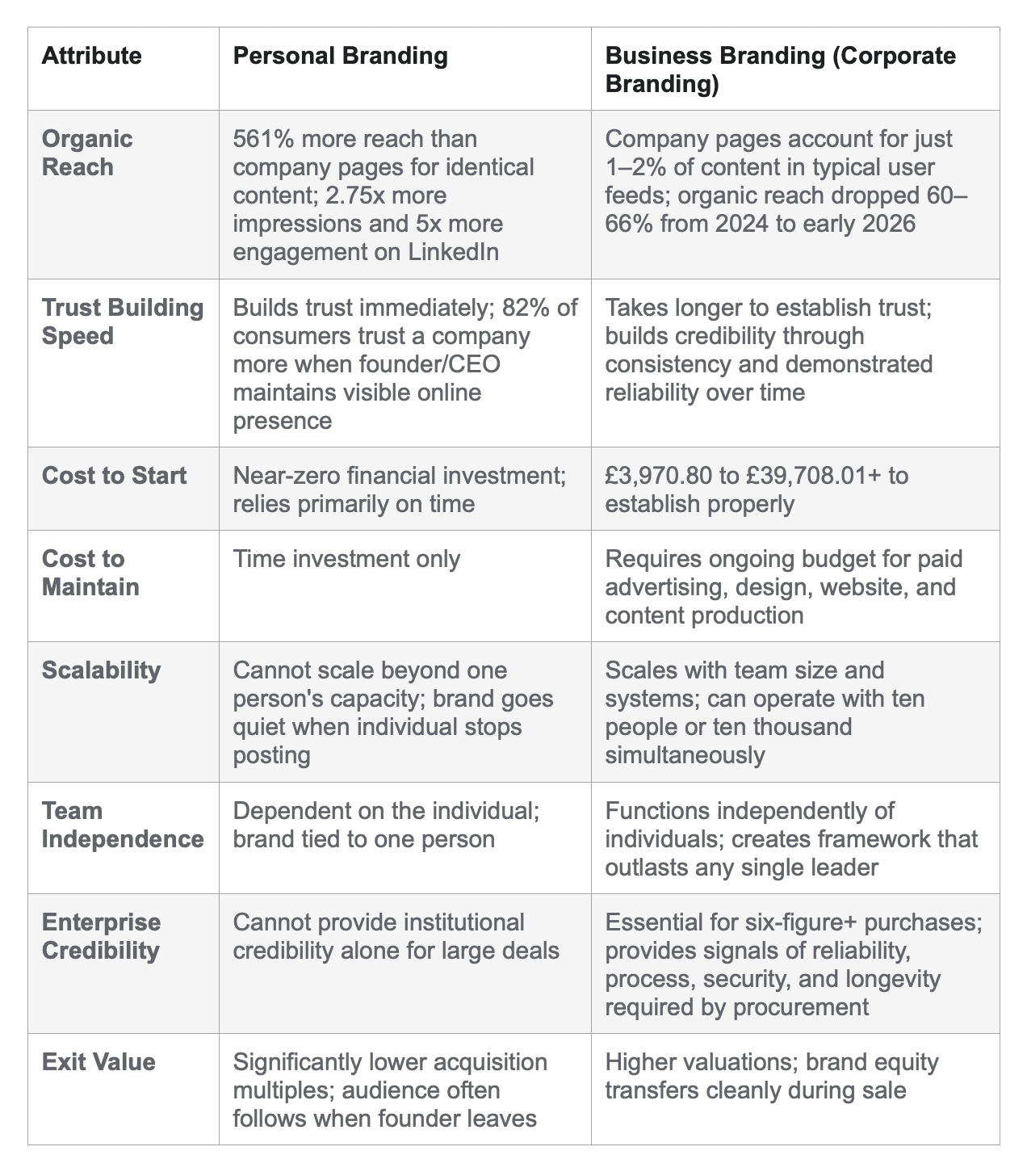
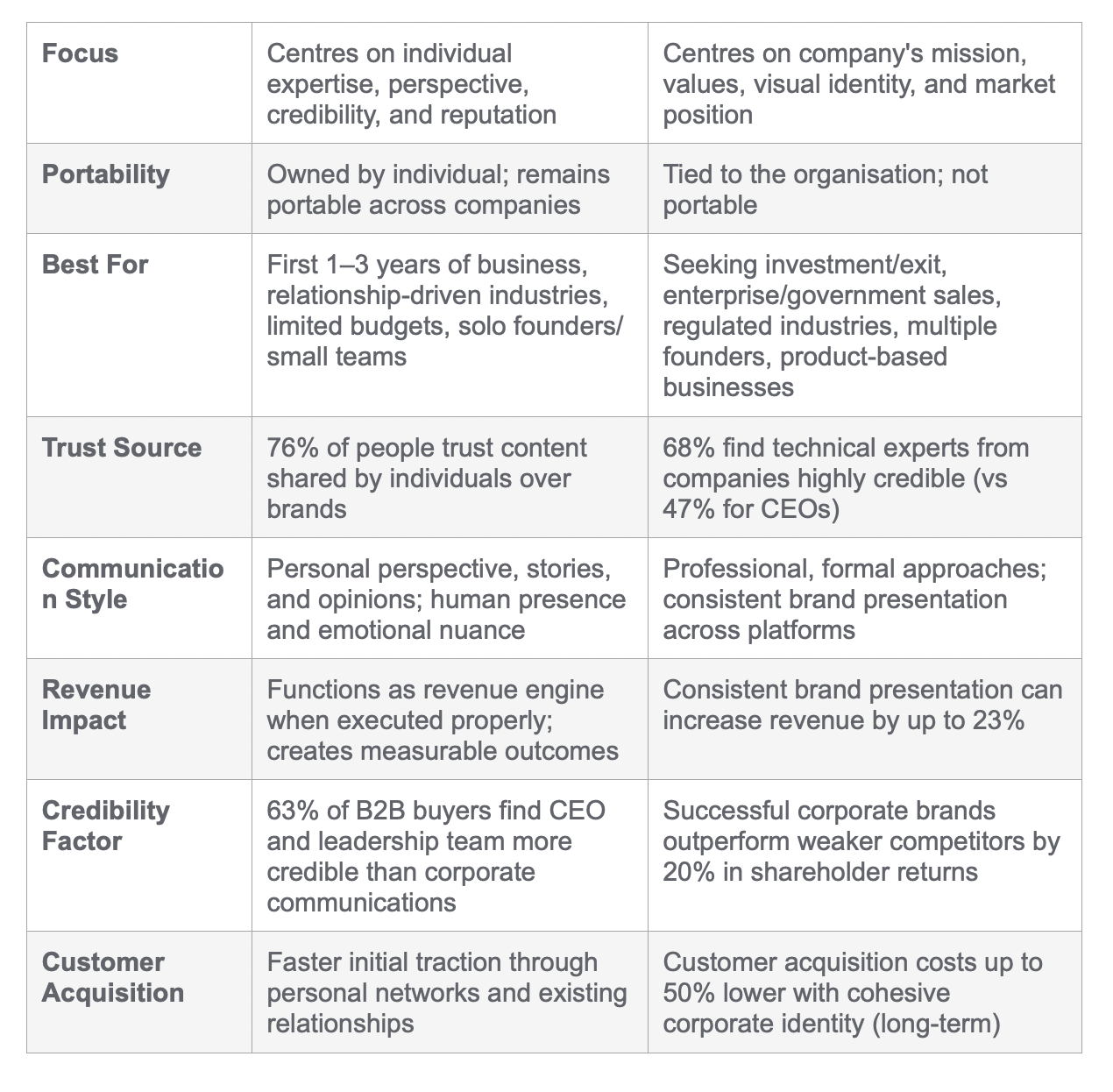
No single row declares a winner. The answer depends entirely on where you are, what you are building, and how fast you need results.
Introduction
Two founders sell the same service at the same price. One posts twice a week under their own name. The other pushes everything through the company page and waits.
Six months later, the first founder is getting inbound leads. The second only has a content calendar and a sense that something is missing.
The difference was not about talent. It came down to distribution.
Many founders then draw the wrong conclusion. They focus only on personal content, build an audience that belongs to them instead of the business, and end up with a company that stops generating demand as soon as they stop posting.
Both mistakes can be costly. This guide explains when a person should lead the brand, when the company should take over, and how to make both work together.
What is personal branding in business?
Personal branding is how people in your market see you as an individual. It is based on your expertise, perspective, experience, and reputation [7].
You build your personal brand through your content, conversations, public appearances, and visible work. You own this brand, and it stays with you even if you leave your company.
How it works now
People still buy from people, no matter how much automation exists. What has changed is the technology that supports those decisions.
AI now sits between you and your buyer. Around 60% of Google searches end without a click because AI Overviews answer the question on the results page [8]. Answer engines like ChatGPT and Perplexity now sit inside the research phase of B2B deals, and they surface named people with consistent, verifiable footprints far more readily than they surface unbranded corporate copy.
Your online presence should be clear and consistent so these systems can recognize and highlight you. If your positioning is vague, it will get lost before anyone even sees it.
AI can create decent content quickly, but it cannot replace years of real experience, specific client results, or strong opinions you are willing to stand by. Buyers want to know who is making decisions at the company, and this interest only grows as more things become automated.
Having a genuine human presence is now a business advantage. Make the most of it.
Why individual profiles out-distribute company pages
The Algorithm InSights 2025 report analysed 1.8 million posts and found company page posts now reach about 1.6% of their followers and account for 1–2% of the LinkedIn feed, down from 7% in 2021 [1]. DSMN8's feed analysis puts personal posts from 1st- and 2nd-degree connections at roughly 62% of the average feed, ads at close to 30%, and company pages at 5% [2].
DSMN8 also studied more than 500,000 employee posts and found original employee content earns nine times the engagement of company-curated content [9].
In March 2026, LinkedIn updated its feed to use an AI-powered ranking model. Now, the system considers both the post and the author's profile, as well as the reader's work history, to determine whether the post is relevant [10]. Corporate language usually fails. This is how it works: people interact with their peers, and the algorithm notices this engagement and boosts the post's reach. Company announcements rarely make it past the first stage.he first stage.
The credibility detail most articles skip
This is where the usual way of thinking does not hold up.
Edelman's data puts technical experts at 68% credibility, regular employees at 54%, and CEOs at 47% [4]. Meanwhile, 63% of B2B buyers rate a company's CEO and leadership team as more credible than corporate communications [7].
Both statistics are accurate and make the same point: buyers trust real expertise, not just job titles. A CEO who shares their ideas is more effective than a corporate press release. A CEO who only posts motivational quotes is less trusted than their head of engineering.
This is why 'personal branding' is not the best term for what drives results. The real key is authority, which comes from sharing your expertise. Anyone in your business with a strong point of view can build authority.
What is business branding (corporate branding)?
Business branding is how the organisation presents itself as an entity. Mission, values, visual identity, market position, and the promises it makes at an institutional level [11].
Business branding affects customers, employees, investors, and the entire market. It grows slowly over time and continues even when people move on.
How corporate branding earns institutional trust
Corporate brands earn trust by being consistent, having strong systems, and demonstrating reliability over many years.
The commercial case holds up:
- Strong corporate brands outperform weaker competitors by 20% in shareholder returns [12]
- Companies with cohesive corporate identity report customer acquisition costs up to 50% lower than those without clear brand architecture [12]
- Consistent brand presentation across platforms lifts revenue by up to 23% [11]
Corporate branding shows your company is stable. Stability makes your business seem less risky, which helps shorten sales cycles [12]. This matters even more when buyers make decisions without ever speaking to your sales team.
What separates it from personal branding
Corporate branding functions without any single individual [13]. Nobody has to be front-of-house for it to work.
As your company grows, having a brand that does not rely on one person becomes necessary, not just convenient, long before you think about selling [13].
The structural differences:
- Focus: the offer and the value proposition rather than one person's characteristics [11]
- Longevity: a structure that lasts beyond any one leader
- Tone: professional and formal, built for wider audiences [11]
- Channels: advertising, digital, PR, and partnerships all working together [11]
When the company name has to do the work
Sometimes, a personal profile will not get you in the door.
Regulated sectors and institutional buyers reward infrastructure, process, and audit trails [13]. Nobody appoints a law firm because the managing partner writes well.
Corporate branding is essential if you plan for a future without yourself in the business. Investors and buyers want companies that can keep going after the founders leave [13]. People who care about stability choose established companies over those built only on personal brands.Personal branding vs company branding: head to head
There are six main factors that determine the outcome, and the results are mixed.
1. Organic reach and algorithm performance
Personal branding wins by a wide margin.
Company pages reach 1.6% of their own followers and hold 1–2% of the feed [1]. Personal profiles account for roughly 62% of it through 1st- and 2nd-degree connections [2]. Employee-original content earns nine times the engagement of company-curated content [9].
It is important to note that the well-known '561% more reach' statistic comes from MSLGroup's Social Employee Advocacy Study, which compares employee-shared brand messages to those on official brand channels [14]. This is not a LinkedIn algorithm number, and the original year of the study is unclear [15]. The general idea is correct, but the number is often repeated without accuracy.
2. Speed to build trust
Personal branding wins here.
82% of consumers trust a company more when the founder maintains a visible online presence [16]. Corporate brands earn credibility too, and they earn it slowly, through repetition and demonstrated reliability [13].
People are already familiar with individuals, while companies have to build recognition from scratch, often by spending money.
3. Cost to start and maintain
Personal branding wins on cost. Corporate branding wins on effort per unit of output.
Personal branding costs your calendar. Corporate branding costs identity work, a site, design, production, and paid distribution, all of which land before the first lead does.
For founders who are self-funding, this makes the order of branding clear.
4. Scalability and team independence
Corporate branding wins in this area.
One person posts so often and no more. When they stop, the brand stops [17]. Corporate brands scale with headcount and systems, and ten people or ten thousand can carry the same message at once.
Personal brands grow quickly, while corporate brands are built to last.
5. Credibility in large deals
The answer is mixed, and common beliefs are not always correct.
Conventional wisdom says nobody signs a six-figure contract off the back of LinkedIn posts. Procurement, compliance, and committee sign-off demand institutional signals that a profile cannot produce on its own [17].
The Edelman-LinkedIn data complicates that neatly. More than 40% of B2B deals stall on internal misalignment, driven by hidden buyers in finance, legal, compliance, procurement, and operations who influence the decision without ever meeting your sales team [18].
Those hidden buyers respond to published expertise:
- 95% say strong thought leadership makes them more receptive to sales and marketing outreach [3]
- 79% say they are more likely to champion a vendor's proposal during the RFP process if that vendor publishes consistently high-quality thought leadership [18]
- 64% say they trust thought leadership over product sheets and brochures when assessing capability [18]
- 51% say it helps them convince C-level executives, and 52% say it helps them persuade other members of the buying group [18]
- Only 41% cite "the safest choice" as a top factor at the moment of decision [19]
In summary, your corporate brand helps you meet compliance requirements. Your personal authority helps convince decision-makers you never meet. Enterprise buyers look for both, but most founders overlook how important personal authority is.
6. Exit value
Corporate branding wins here, for a reason worth stating clearly. They discount key person dependency, and the M&A market has a name and a price for it.
Significant dependency typically costs 0.5x to 1.5x off the multiple [5]. In the UK SME market, a heavily owner-operated business commonly loses 0.25x to 0.75x [6]. Key-person dependency ranks as the most frequently cited value suppressor in SME transactions, and buyers respond by cutting the headline multiple, pushing consideration into an earnout, or walking away [20].
Read the definition carefully. The discount is tied to client relationships, technical knowledge, and market reputation that reside with the owner and cannot be transferred [20]. A founder with 40,000 followers and a second-tier management team, documented systems, and demand that routes through the company carries far less of that risk than a quiet founder who personally owns every account.
Use your personal brand to generate demand. Build your corporate brand so demand continues even after you step back.
When personal branding is the right call
You are in years 1 to 3
If your company has no brand equity, your reputation is your main asset, so use it [17].
No one is searching for your company name because they do not know it yet. But people in your network already know you and will notice what you share. You sell in a relationship-driven market.
Consulting, professional services, coaching, financial advice, creative services. Clients choose the person delivering the work, and the entity on the invoice barely registers [17]If you hide behind your company logo in these markets, you lose your main advantage.ge.
Your budget is tight.
You can build a strong audience on LinkedIn by investing your time. Corporate branding requires money before you see any results [17]. There is no cheaper way to get noticed. a solo founder or a small team.
Someone nSomeone needs to be the face of the business. If you are a solo founder, the choice is simple [21].A strong brand also connects your different offers, so each product feels like it comes from the same source [21].
When business branding is the right call
You are raising or planning an exit.
Investors and buyers buy companies, not personal followings.
Brand equity transfers cleanly in a sale [22]. Founder-synonymous businesses hit the key person discount described above, and buyers price that risk into the offer or into an earnout [5] [20].
Start building your corporate brand earlier than you think you need to. It takes years to gain recognition, and exit opportunities may come before you are ready.
You sell to enterprise or government.
Public sector buyers cannot simply pick a supplier they like. They score submissions against published criteria and document every decision for audit [23]. The UK public sector runs hundreds of billions of pounds through formal procurement, with award cycles running one to two years [24].
Committees look for corporate signals to justify spending. Share thought leadership to influence decision-makers, and support it with a company structure that meets procurement requirements.
You operate in a regulated industry.
Healthcare, finance, legal, insurance. 75% of B2B buyers say brand reputation carries significant weight on purchase decisions in these sectors [25].
In these industries, compliance is part of the content process, not something added later. All claims are checked before publishing [26]. Corporate branding shows that discipline matters, and in fields where accuracy is most important, this adds real value [26]. If your company has several founders or leaders, no one person should be the only face of the business.ess.
Share visibility among your leadership team [27]. This shows your company has depth, increases your reach, and protects the business if a leader steps away.
You sell a product rather than a service.
Physical and software products need their own identity, separate from any individual [28]. Buyers care about what the company offers. If you separate the two early, your product's identity will grow stronger and faster.
The 2026 play: build both, in sequence
Do not treat this as an either-or decision. Build both personal and business brands, and shift your focus as your company grows.
At Kurogo, we run this as three moves: Position, Amplify, Convert. In that order.
Position: Choose how you want buyers to see you. Focus on your promise, proof, and how you present yourself. If you skip this, your content will blend in with everyone else's.
Amplify: Share your ideas widely using organic, paid, and earned channels. If you do not, your good work will go unnoticed.
Convert: Turn attention into business by capturing leads, nurturing them, and making offers. If you skip this, you will have an audience that never becomes customers.
Each step supports the others. Positioning makes your content credible. Amplification makes your positioning visible. Conversion turns trust into sales.
Phase 1: lead with the person (months 1 to 12)
At first, your corporate brand will not be recognized. Accept this and avoid spending money on it yet.
Post as yourself. Share your expertise, not just announcements. Mention the business when relevant, but keep it out of the spotlight.
Your personal profile will get more attention than your company page at this stage. Use the first year to find out which ideas connect with your audience.
Phase 2: build the bridge (months 12 to 24)
Link the trust and credibility you have built to your company.
Introduce corporate content alongside your own. Tag the company. Publish client outcomes with the company's name. Put your team's experts in the feed under their own names, since Edelman's numbers show buyers trust them more. The goal is to make your company look credible, even when you are not the one posting every time.
Phase 3: shift the weight (year 2 and beyond)
As your company becomes more recognised, shift more focus to it.
Corporate channels should handle announcements, launches, and case studies. Your personal profile should focus on thought leadership that goes beyond your own product.
You become known as a leader in your field, and your company becomes the evidence that your expertise has real value.
What this looks like in practice
Sara Blakely built Spanx on founder storytelling, sharing failures and controlling the narrative from the start [29]. Whitney Wolfe Herd treated Bumble as a brand before a tech company and took it public at 31 [30] [31].
Both examples are large US consumer businesses, which may be bigger than most readers' goals. The key point is that personal credibility opened the market, and the company's identity kept it.
This approach works just as well for a £2M business in Guildford as it does in Austin. The founder attracts attention, and the company benefits from that attention.
There is no single winner in every category. Each factor shows you where to invest your efforts. Every row tells you when to spend.
Conclusion
Personal branding and business branding meet different needs. Founders miss out when they see them as competitors instead of complementary.An individual can attract attention more effectively than a company page. The company then holds onto that value, helping it get through tough times, leadership changes, or a sale.
For most UK founders, the process usually looks like this:
- Year 1: lead personally, because the company has nothing to lead with.
- Year 2: build the bridge, connecting your credibility to the entity that will keep it.
- Year 3 onward: shift the weight to the company while your own authority moves up to category level.
If you get the order right, both personal and business branding will grow together. If you get it wrong, you might be ignored behind an unknown logo or risk losing your business when you leave.
Being well-known is more valuable than just being the best. Being well-known and having a brand you can transfer is valuable. Book a Kurogo authority audit. We will show you where your positioning, distribution, and conversion are leaking, and give you a plan for the next 90 days.
FAQs
Does personal branding still generate pipeline in 2026, or is it noise?
Personal branding generates leads when you treat it as a system, not just a way to build an audience. Focus on three questions: who you help, what problem you solve, and why people should trust you. If you answer these clearly and consistently, the right buyers will find you. The noise comes from founders sharing opinions without clear positioning or a plan to turn interest into business.
Could a startup pick personal branding or business branding?
Lead personally for the first one to three years. Your company has no recognition, and your reputation costs nothing to use. Add corporate elements around month 12 and shift focus as recognition grows. Founders who skip the personal phase spend years buying attention they could have earned.
Will a strong personal brand hurt my exit valuation?
The personal brand does not cause the discount. Key person dependency does, and buyers price it at about 0.25x to 1.5x off the multiple. If your client relationships, market reputation, and demand generation all depend on you and cannot be transferred, that is the risk they price in. Route demand through the company, build a second-tier management team, and document your systems. Then your visibility becomes an asset, not a liability.
How much personal content should the founder produce versus the team?
Spread it out. Edelman's research shows technical experts have 68% credibility compared to 47% for CEOs, so your engineers, analysts, and delivery leads have more trust with buyers on technical questions. Founder-led is the starting point. Team-wide authority is the scaled version, and it lasts even if someone leaves.
Is it the fastest way to build authority from zero?
Pick one platform where your buyers already spend time and focus there. Aim for about 80% value and 20% positioning. Publish three times a week for six months instead of daily for three weeks, because consistency builds results and intensity does not. Commenting with substance on relevant posts often brings in more leads than your own content in the first 90 days.
References
- Entrepreneur, Organic Reach On LinkedIn Is Cratering. Here's How To Revive Yours (Algorithm Insights 2025 Report, 1.8 million posts analysed). https://www.entrepreneur.com/growing-a-business/organic-reach-on-linkedin-is-cratering-heres-how-to/497713
- DSMN8, LinkedIn Organic Reach Investigation. https://dsmn8.com/blog/linkedin-organic-reach-investigation/
- Edelman, The Challenger Opportunity: Why Bold Content Levels the B2B Playing Field. https://www.edelman.com/insights/bold-content-b2b
- Content Marketing Institute, How To Make Personal And Corporate Branding Work Together (Edelman Trust Barometer data). https://contentmarketinginstitute.com/audience-building/how-to-make-personal-and-corporate-branding-work-together
- LegacyVector, Key-person Risk, M&A Glossary. https://legacyvector.com/glossary/key-person-risk
- Lansley Commercial, Owner Dependency Small Business Valuation UK Explained. https://www.lansleycommercial.co.uk/owner-dependency-small-business-valuation-uk/
- Sid, Personal Brand vs Business Brand: A B2B Guide. https://www.heysid.com/resources/personal-brand-vs-business-brand-b2b-guide
- Leadership Visibility, Personal Branding in 2026. https://www.leadershipvisibility.co.uk/blog/personal-branding-in-2026
- DSMN8, The Social Media Manager's Guide to the LinkedIn Algorithm in 2026 (500,000 employee posts analysed). https://dsmn8.com/blog/the-social-media-managers-guide-to-the-linkedin-algorithm-in-2026/
- ZoomSphere, LinkedIn Algorithm 2026: Why Generic AI Content Kills Your Organic Reach (Whitehat analysis of Socialinsider data). https://www.zoomsphere.com/blog/linkedin-algorithm-2026-why-generic-ai-content-kills-your-organic-reach
- Ramotion, Personal Brand vs Business Brand. https://www.ramotion.com/blog/personal-brand-vs-business-brand/
- Helms Workshop, Corporate Branding. https://helmsworkshop.com/blog/corporate-branding
- Forbes, Jodie Cook, Personal Brand Or Business Brand: Which Should You Build?. https://www.forbes.com/sites/jodiecook/2024/11/05/personal-brand-or-business-brand-which-should-you-build/
- Sprout Social, What Is Employee Advocacy and Does It Really Work? (MSLGroup Social Employee Advocacy Study). https://sproutsocial.com/insights/what-is-employee-advocacy/
- Oktopost, Employee Advocacy Statistics 2026 (notes MSLGroup publication year unconfirmed). https://www.oktopost.com/blog/employee-advocacy-statistics-2026/
- Co&Co, Building A Personal Brand To Bring Awareness To Your Business. https://wearecoandco.com/building-a-personal-brand-to-bring-awareness-to-your-business
- Bear My Brand, Personal Branding vs Corporate Branding 2026. https://bearmybrand.com/blog/personal-branding-vs-corporate-branding-2026
- Edelman, The Rise of the Hidden Buyer: Rethinking B2B Influence Beyond the Obvious. https://www.edelman.com/insights/hidden-buyer-b2b
- Edelman and LinkedIn, 2025 B2B Thought Leadership Impact Report (1,934 management-level professionals across 7 markets including the UK, fielded 17 March to 3 April 2025). https://www.edelman.com/expertise/Business-Marketing/2025-b2b-thought-leadership-report
- Blacks Brokers, Business Valuation Methods Used In UK. https://www.blacksbrokers.com/business-valuation-methods/
- Emily Banks Creative, Personal Branding For Online Business Owners. https://www.emilybankscreative.com/articles/personal-branding-for-online-business-owners
- Paige Brunton, Personal Brand vs Business Brand. https://www.paigebrunton.com/blog/personal-brand-vs-business-brand
- Stotles, Business to Government (B2G). https://www.stotles.com/glossary/business-to-government
- Cadence Marketing, Building A B2G Marketing Strategy From The Ground Up. https://www.cadencemarketing.co.uk/building-a-b2g-marketing-strategy-from-the-ground-up-part-1/
- Nu Creative, How Investing In A Strong Brand Can Help Grow Your Business In A Regulated Industry. https://www.nucreative.co.uk/blog/how-investing-in-a-strong-brand-can-help-grow-your-business-in-a-regulated-industry
- Forbes Communications Council, Marketing In A Regulated Industry: How To Balance Creativity And Compliance. https://www.forbes.com/councils/forbescommunicationscouncil/2025/02/05/marketing-in-a-regulated-industry-how-to-balance-creativity-and-compliance/
- Brand of a Leader, Executive Branding For Founders And CEOs. https://www.brandofaleader.com/blog/executive-branding-for-founders-ceos
- Cult Method, Personal vs Business Brand. https://cultmethod.com/articles/personal-vs-business-brand/
- Forbes Books, Personal Branding vs Corporate Branding: Why You Need Both. https://books.forbes.com/blog/personal-branding-vs-corporate-branding-why-you-need-both/
- Time, Whitney Wolfe Herd. https://time.com/5947727/whitney-wolfe-herd/
- Wikipedia, Whitney Wolfe Herd. https://en.wikipedia.org/wiki/Whitney_Wolfe_Herd
Ready To Become Your Industry's Go-To Thought Leader?
Kurogo is the go-to agency for turning your personal brand into a business-growth machine.
Related Posts
Elevate Your Personal Brand and Position Yourself as an Industry Leader.


Leaders We’ve Worked With
At Kurogo, we've had the privilege of working with a diverse range of professionals, from industry-leading CEOs and eCommerce entrepreneurs to innovative thought leaders and creatives.


